

Bibi Reisdorf at the Global AI & Inclusion Symposium in Rio de Janeiro

Global symposium on AI & Inclusion in beautiful Rio de Janeiro

The Museum of Tomorrow

Last week, I had the immense pleasure of participating in the Global AI & Inclusion Symposium at the Museum of Tomorrow in Rio de Janeiro, Brazil. The Global Network of Internet & Society Centers (NoC) invited a wide range of stakeholders toRio during November 8-10, 2017. Spearheaded and organized by the Berkman Klein Center for Internet and Society at Harvard University and the Institute of Technology and Society in Rio, the symposium brought together researchers, industry, NGOs, and other entities to discuss issues around inclusion and artificial intelligence (AI).

One of the key aspects of this symposium was the inclusion of perspectives fromnot only a wide range of areas and disciplines, but also from all regions across the globe. Each region was represented—however, more inclusion of underrepresented areas was noted as an area of action for future activities, as the discourse still saw a larger number of perspectives from Western backgrounds. As an example, although China is one of the key players regarding AI, only a small number of representatives were from China or provided a background on AI and inclusion in China.

The symposium was jam-packed with high-caliber talks, discussions, and activities. The symposium program can be found here. Whereas the first day focused on creating a common understanding of AI and inclusion as concepts and frameworks, the second day identified opportunities, challenges, and possible approaches and solutions to increase inclusion in AI, and the third day focused on areas for future research, education and interface building.

All speakers provided impressive background and knowledge on AI and inclusion to a multidisciplinary and multifaceted audience, which created a steep learning curve for me as a social scientist with (previously) little background in the technologies behind AI. However, the design of the symposium talks and activities facilitated a deep understanding of the issues around AI and inclusion for individuals from any disciplinary background.

Key issues in AI and inclusion 
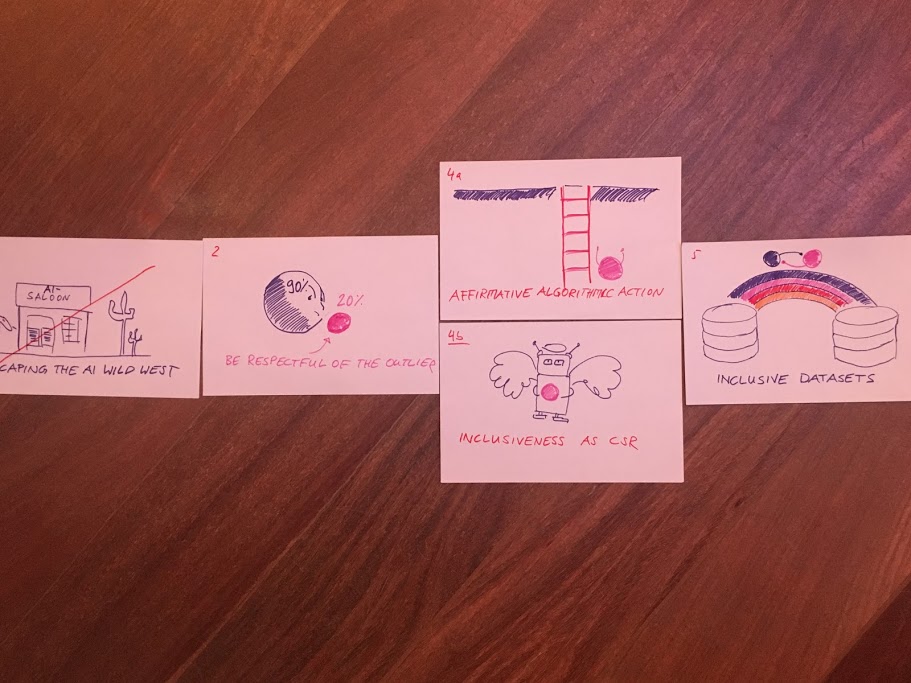
Our cluster group’s suggestion on how to escape the AI Wild West and move toward unbiased (or less biased at least) AI

One of the key issues that stood out at this symposium is the bias and the exclusionary nature of AI through the way that AI is created and trained. For example, algorithms, which are an inherent part of AI, that are created through training datasets are only as good as those datasets. This means, if a training dataset—created by a human—is biased, the algorithm will be biased too. This became apparent quickly through a variety of examples, that included work from Desabafo Social, a non-profit that promotes social justice and youth participation in Brazil, which showed videos that revealed racist bias in search algorithms for a variety of photo sharing pages. An impressive example of their enlightening videos can be found here.

These issues of bias and exclusion at the creation stage do not just include race as a factor, but any underrepresented group. For example, the technology created for airport security prompts the security agents to choose whether a person is male or female before entering the millimeter wave scanner. Based on training datasets of typical male and female bodies, the scanner then decides whether there could be any objects hidden on those bodies. However, this AI technology (Automatic Target Recognition, ATR) only differentiates two genders, meaning that anyone who does not fall into these two categories will be marked as suspicious and will have to go through a secondary security hand search.

Another striking takeaway from the conference was the missing legal definition of AI and the absence of global standards in AI. For example, AI accuracy in face recognition is very high for white males, but low for black females. A good practice standard, for example a minimum accuracy requirement, does not currently exist, although a number of entities, such as the Mozilla Foundation, are aiming to create such standards as a “fair AI” badge—similar to the fair-trade badge—to remedy these issues.

Another area of concern in AI is privacy and surveillance, as AI relies on copious amounts of data to learn and improve its algorithms. However, users are often unsure of when, where, and how their data are collected and used for which purposes. Although some regulations have been passed to protect users’ privacy, these regulations are not global, and different regions apply different laws and regulations. Accordingly, there were calls for—first of all—a global legal definition of AI, which

The Berkman Klein and ITS Rio team who organized the symposium

would provide the basis for creating global regulations on inclusion, privacy, and other areas affected by AI. Again, the Mozilla Foundation made a number of suggestions on “fair AI” and they provide a “holiday buyer’s guide” on technology that will “snoop” on you—i.e., presents that you should probably not give to your loved ones… unless you’d like them to be snooped on…

Future Event on AI, bias, and inclusion at the Quello Center

Overall, the symposium left me personally with more questions than answers, but I am consoled by the fact that every single participant I spoke with felt invigorated and motivated to do something to move forward the cause of increasing inclusion in AI. For one, we all agreed to help make these issues a public conversation topic—this blog post is only the start. At the Quello Center, I will be organizing a discussion roundtable concerning issues around artificial intelligence, bias, and social exclusion, that will delve deeper into these issues based on the work that is happening here at MSU. Watch this space for a time and date during the spring semester 2018.


Primary takeaways

  • Digital inequality shows larger impacts on youth academic performance as compared to time spent on screens.

  • Digital skills play a significant role in mediating unstructured online engagement (social media use, playing video games, browsing the web) and youth academic, social, and psychosocial development.

  • Unstructured online engagement and face-to-face social interaction are complementary and continuously interact to create and enhance youth capital outcomes.


A familiar story: concerns of screen time

Today’s discussions of adolescent well-being have coalesced around a clear narrative: teenagers spend too much time online, and their academic performance, mental health, and social lives are deteriorating as a result. A steady stream of academic papers, books, and op-eds, alongside a growing number of policy proposals––school phone bans, age-gated social media use, restrictive screen-time limits––rest on the same underlying claim, aligning with a contemporary, digitized version of the displacement hypothesis:

Screen time, particularly the unstructured, free-time spent on social media, gaming, watching video content, or browsing the web, is said to displace the productive face-to-face activities that build adolescents into capable adults.

The implied and often practiced solution is restriction. In response, this dissertation tested this claim directly, and placed it within the broader context of adolescence.

Across three years, I followed 653 Michigan adolescents from early through late adolescence: in grades 8 or 9 (survey one, 2019) to grades 11 or 12 (survey two, 2022). Notably, these students, studied over time, were part of a broader pooled sample of 5,825 students across the same eighteen highschools. The study window captured the year before and the year after the peak of the COVID-19 pandemic and related lockdown orders, functioning as an unprecedented stress test for theories of adolescent social, academic, and digital life and, importantly, as a benchmark to compare the effects of pandemic-related change and inequality to those effects from screen time alone.

Across four studies of adolescents, consisting of six cross-sectional and longitudinal analyses, findings are not consistent with the displacement narrative, nor the broader concerns about the time youth spend on screens.

Findings are, however, consistent with something the current public and (most) academic discussions have largely overlooked or ignored: the gaps and inequalities that determine whether adolescents can access and use the internet meaningfully in the first place.

What the displacement hypothesis overlooks

Displacement and related research and policy concerning the time young people spend online assumes a “zero-sum” model of adolescent day-to-day time. An hour online is an hour not spent studying, reading, sleeping, or interacting face-to-face (i.e., time spent on more productive or developmentally “better” activity).

Indeed, this makes sense logically. However, as an empirical claim, this model requires time spent online to behave differently from all other ways adolescents allocate time; it must produce uniquely negative outcomes and be inherently harmful across digital contexts, rather than the typical mix of trade-offs corresponding to, and often overlooked among any other social or developmental context.

Yet, online time does not differ from other youth activity. Instead, I find it has a mix of pros, cons, and even some “uniquely digital” benefits which youth utilize for social and academic gains. When I compared unstructured digital media use against traditional face-to-face interaction and activities, both produced similar patterns: some negative associations with academic outcomes, some null, and some positive.

Trade-offs within traditional face-to-face activity (for example, social time with friends and family, or time spent in after-school extracurriculars) are treated as ordinary developmental experiences that must be experienced for the betterment of development. The identical trade-offs involving digital time tend to be overlooked or ignored, and online engagement is perceived as altogether harmful.

A growing body of evidence, including this dissertation, do not support that distinction. Indeed, the developmental context is routinely misread, leaving out the context of the experiences and time spent on digital, as well as face-to-face activities, interactions, existing inequalities, and changes inherent to development. As such, I proposed a novel framework to understand these contexts:

Digital capital exchange

Rather than treating screen time as a unified harm, this dissertation advances an exchange”-based framework, grounded in James Coleman’s theories of youth capital and digital inequality scholarship, particularly following Eszter Hargittai, Jan van Dijk, and Alexander van Deursen (see this list of all dissertation references for full works).

The core proposition is that adolescents’ online engagement is not an alternative to developmental activity but another, albiet modern domain through which young people accumulate and mobilize online resources––particularly digital skills––that work alongside existing social networks and experiences to be exchanged for human capital (measured as: academic achievement, aspirations, STEM interest) and social capital (peer networks, community participation, extracurricular involvement).

Online time is not the mechanism; instead, it is digital skills that I find to be the most vital component in youth capital exchange and enhancement. Unstructured online engagement contributes to online skills; those skills, accumulated and mobilized alongside existing peer, family, and community networks, translate into the outcomes researchers and parents care about, i.e., academic achievement, aspirations, and face-to-face interaction and social networks.

This digital capital framework treats online and in-person contexts as complementary rather than antagonistic, and it situates adolescents’ digital lives within the structural conditions––connectivity quality, device reliability, autonomy of use––that determine whether exchange can occur at all.


Methods (in brief)

Paper-and-pencil surveys were administered to students in classrooms at two time-points: spring 2019 (N=2,876) and spring 2022 (N=2,949), across the same eighteen predominantly rural Michigan schools, grades 8–12. Official, nationally-ranked standardized reading, writing, and math test scores (PSAT 8/9, PSAT 10, SAT; College Board) were then anonymously linked to students’ survey responses with the help of participating districts.

Cross-sectional path analyses modeled pooled and wave-specific samples (pooled N=5,825); two-wave cross-lagged panel models tested reciprocal, longitudinal relationships on the 653 students who completed both surveys. Multi-group analyses of the cross-lagged panel models compared relationships between girls (N=345) and boys (N=308). All longitudinal models included time-invariant socioeconomic covariates as well as time-varying covariates to reduce omitted-variable bias.

Key findings: an overview

To summarize, to the best of my ability, eight chapters across 376 pages, I present two primary findings:

First: digital inequality predicted larger and more consistent declines in human capital than screen time did.

Unreliable home internet and technology maintenance problems––experiencing and/or dealing with broken or outdated devices and software, restrictive school-issued hardware, issues with connecting to or maintaining internet access––decreased youth GPA and standardized test achievement. And, these effect sizes were substantially larger than any negative direct effect from unstructured digital media use.

Across all four empirical studies, digital inequality emerged as the most substantial predictor of academic and developmental decline.

Second: digital skills mediated the relationship between online time and adolescent academic and social outcomes.

Unstructured digital media use, particularly online gaming and web browsing, predicted higher internet and social media skills for adolescents, which in turn predicted stronger academic achievement and self-efficacy (human capital), and social interaction and extracurricular participation (social capital). The positive indirect effect of screen time through skills offset or exceeded any small negative direct effects across several outcomes (supporting our existing peer-reviewed work: Hales & Hampton, 2025, and which you can read more about here).

These exchange processes were amplified when peer and family networks were modeled alongside digital skills, consistent with the premise that online and offline contexts operate together rather than in competition. The effect was not universal: social media skills amplified rather than offset a negative association with consistency of interest, one of the two subscales of grit. The exchange framework describes a contextual and conditional, domain-specific mechanism, not a blanket defense of time spent online.

Implications

If digital inequality, and not screen time, is the primary predictor of adolescent academic and developmental decline, and still warrants concern regarding access quality and experience even with the broader adoption of digital devices across the United States, the current policy emphasis on restriction is pointed at the wrong target. The evidence supports a different set of priorities.

Stable, reliable home (fast) broadband should be treated as an educational prerequisite rather than a consumer amenity. Unreliable connectivity exerted larger downward pressure on human capital than any measure of screen time, and that pressure intensified during the pandemic-era reliance on digital infrastructure. Technology maintenance, device repair, replacement, technical support, and the flexibility to install software and explore the web autonomously, matters as much as initial access, and school-issued devices that restrict autonomous use appear to hinder skill accumulation rather than support it.

Restrictive parental mediation of internet use was negatively associated with grit and self-efficacy at magnitudes comparable to the positive contributions of face-to-face activity. This challenges the assumption that digital restriction functions protectively. Instructive mediation, teaching adolescents to verify information, navigate platforms critically, and mobilize online resources toward meaningful ends, is the posture the data supports.

Finally, the technical skill-building that occurs through gaming, self-directed exploration, and deep web use is skill-building, not wasted time. Closing the persistent gender gap in these domains likely requires legitimizing technical play for girls, rather than restricting it for everyone.

None of the above is an argument that screen time is benign. It is an argument that screen time is the wrong focus, particularly when studied mostly in isolation. Context matters substantially, whether that is time spent on other activities during adolescence, the period of adolescence itself, digital inequality, resources gained from such online use, and how all such factors interact. The factor that predicts whether a given adolescent can convert online engagement into capital outcomes is structural: access, infrastructure, skills, and the autonomy to use them. These factors are distributed unevenly, and its uneven distribution, not hours logged, is what separates adolescents who thrive from those who fall behind.

The full dissertation is available through Michigan State University’s ProQuest archive, or see the embedded full-text PDF below. I’m happy to share papers, preprints, or the underlying framework with anyone interested and working in this area––don’t hesitate to reach out via my contact form. Thanks for reading.

Tags:

Bibi Reisdorf at the Global AI & Inclusion Symposium in Rio de Janeiro