By William H. Dutton, originally posted on Substack – https://williamhdutton.substack.com/
Not a day goes by when someone does not blame a problem on social media. A top journalist at The Financial Times wrote about the ‘social media ‘monster’’, in this case focusing on the use of mobile and social media can be addictive for some users (Thornhill 2025). Its squares with common sense, right? Our youth are looking at Not a day goes by when someone does not blame a problem on social media. A top journalist at The Financial Times wrote about the ‘social media ‘monster’’, in this case focusing on the use of mobile and social media can be addictive for some users (Thornhill 2025). Its squares with common sense, right? Our youth are looking at their smart phones and viewing (not reading) social media feeds, rather than reading books, news, or even, speaking with you or their friends, or even watching television!
Given such perceptions, many parents, educators, and legislators are strictly limiting, if not banning, its use. Nations, such as Australia, are applying age-based restrictions, such as for under-16s, and others are considering such bans.[i]
A recent Demos report on social media was based on workshop discussions with around 700 children (Gamote and Hyman 2025). As the foreword to the Demos report notes, the authors “travelled across the country and ran workshops with 16-18 year-olds asking them questions about their lives on and off social media, the people who influence them, the politics this fuels and the futures they hope for.”
I am sure the authors of this report gained a strong personal sense from these discussions that they knew what young voters think about social media. Based on these discussions, one of the co-authors of the report said he shifted from being a sceptic of banning social media to arguing that it would be ‘immoral for anyone under 16 to have access to TikTok’, one of the most popular social media of the day (quoted in Thornhill 2025).
Is he right? Is the use of social media undermining the learning and education of our youth? It is not easy to answer this question since there is very little high-quality research on these issues to provide a definitive answer. Listening to teens talking about social media is better than nothing but it is not research. For instance, ask any young person who uses a smartphone if they are addicted to it and they will almost inevitably exclaim they are, but with a smile. While you might find cases or anecdotal evidence, there is little or no systematic empirical evidence that the use of the Internet or social media is addictive from a mental health standpoint.
Briefly, from research available and underway, I don’t think the evidence will support that restrictive position on social media use. There is seriously credible counter-vailing evidence from systematic empirical research conducted and underway that social media plays a positive role in learning and education. Let me provide a recent example from my discussion with sociologists of media and information at the Quello Center at Michigan State University. [Years ago, I was a director of the Center, and remain on the Advisory Board, allowing me to learn of this research. But it is not my research.]
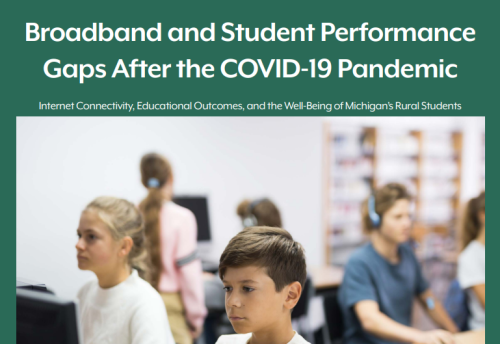
The Quello Center research led by Keith Hampton has been based on systematically administered structured questionnaires completed by thousands of students (grades 8-11) in rural Michigan, before and after the pandemic. They used paper-based questionnaires so that they could survey children who did not use computers or smartphones. Their surveys were conducted in conjunction with schools in the region so that each student’s self-reported questionnaire responses, such as on their well-being and grades, could be kept anonymous but still linked to their records, such as their SAT (Scholastic Aptitude Test) scores (Hampton and Shin 2023; Hales and Hampton 2025). It was illustrative of the kinds of research required to sort out many of these issues.
The Quello researchers have results from their first wave of the study (Hampton and Shin 2023; Hales and Hampton 2025) but are still in the process of completing the analysis of the longitudinal data. Specifically, a doctoral thesis by Gabriel Hales is in progress of completion and an academic paper based on change overtime in self-esteem is under review. While I can’t speak of the work under review, I can provide my sense of their first wave of research and the progress of their work to-date. The issues are too important to policy and practice to not be briefly characterized.
Most generally, their work has found that the use of social media is indeed related to positive educational and psychological outcomes. This research makes it clear that the relationship is far more complex than is commonly recognized. There are many direct and indirect relationships, such as tied to the development of digital skills, which is an important mediating variable. However, indicators of academic achievement, as well as social psychological indicators, such as of self-esteem, are stronger among youth who have good access to social media, such as at home or libraries. Even heavy users of social media fare better than those without access to social media on important indicators such as academic achievement and aspects of psychological and social well-being, such as self-esteem.
Therefore, before you (your school, government regulators) ban social media too quickly, let me make two points.
First, we need to wait for serious research on these issues. Follow the work at the Quello Center as it progresses.[ii] You may view social media as nothing new, but it is indeed relatively new if compared to such media as television and film, which raised similar issues about our psychological well-being and academic performance. But as my example suggests, there is research on its way that will provide more definitive evidence of the actual implications of social media use. As the authors, Gabriel Hale and Keith Hampton (2025) put it:
‘These findings challenge the simplistic view that unstructured leisure time spent on digital media is inherently harmful or unproductive. We underscore the need for shifts in policy and parenting practices to recognize the benefits of casual leisure and unstructured time with peers, both online and offline, for learning and development.’
Secondly, as with television, how parents interacted with children was one of the most important factors shaping the impact of television on learning and education. In early stages of Internet diffusion, parents often did not know what children were doing on the Internet and social media. Kids often had more digital skills than their parents. And, in contrast to TV, they did not use their computer or phones for all to see in the family living room.
Overtime, as the Internet and social media have become more ubiquitous, parents know more about their children’s use, such as the amount of screentime they spend on their smartphones or computers. Many platforms inform users about how much time they spend online. Parents, teachers, coaches and families need to talk about their use of social media to catch problems, such with unhealthy content, which can be avoided. (I trained TikTok to show me world news and stand-up comedians.) Discuss serious risks online, such as exposure to bad actors and harmful content, such as hate speech.
Most importantly, try to encourage children and teens to balance the use of social media with reading, books (the new cool medium), television, and interpersonal communication, such as conversations. Just as you want to expose youth to many sports and subjects, you want them to gain experience in the use of a wide range of media and information technologies.
Many actors are trying to address the risks tied to being online. You, your family, schools, internet platforms, regulators, and all relevant actors should make decisions about how to constructively use social media based on evidence as opposed to demonizing rhetoric. Exaggerated fears can have negative consequences.
In short, conventional wisdom can be wrong and misleading. The appropriate use of the Internet, social media, and – dare we say – AI, can and usually does support leaning and education. Don’t disadvantage your children or students by over-regulating their use of one of the most powerful educational technologies available to them. In fact, ensure they have access and use that access appropriately.
References
Gamote, S., and Hyman, P. (2025), Inside the Mind of a 16-year-old: From Andrew Tate to Bonnie Blue to Nigel Farage – what do first time voters think about social media, politics, the state of Britain and their futures? London: Demos, November.
Hales, Gabriel E. & Keith Hampton (2025). Rethinking screen time and academic achievement: gender differences and the hidden benefit of online leisure through digital skills. Information, Communication & Society. https://doi.org/10.1080/1369118X.2025.2516542
Hampton, Keith & Inyoung Shin (2023). Disconnection More Problematic for Adolescent Self-Esteem than Heavy Social Media Use: Evidence from Access Inequalities and Restrictive Media Parenting in Rural America. Social Science Computer Review. 41(2), 626-647 https://journals.sagepub.com/doi/full/10.1177/08944393221117466
Thornhill, J. (2025), ‘Tackling the social media ‘monster’’, The Financial Times, 13 November: 23.
[i] https://www.bbc.co.uk/news/articles/c89vjj0lxx9o
[ii] Published articles of the Quello Center are linked on the Center website at https://quello.msu.edu/articles-books-chapters/