

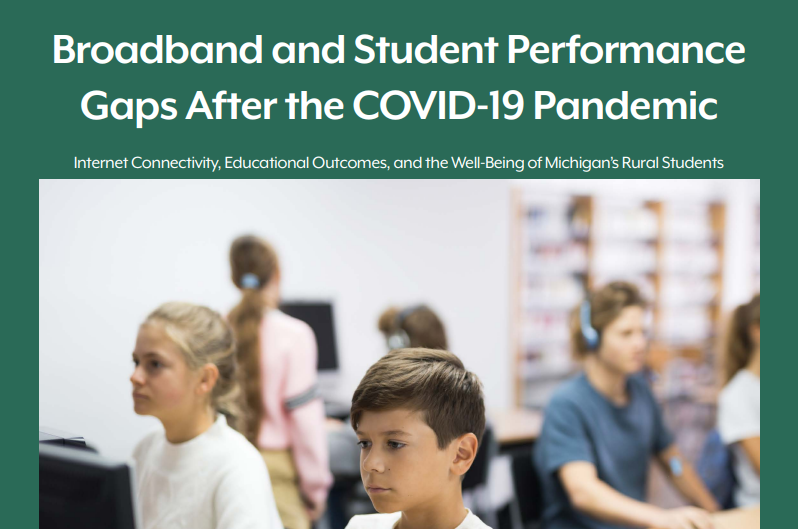
MSU study: Pandemic gains in broadband access for rural students are fading

Broadband cover

A new study from Michigan State University warns that gains made to address broadband and internet connectivity in Michigan rural communities are beginning to fade.
According to MSU research, one in three, or 32.5%, of rural students still lack adequate, fast broadband home internet, despite progress achieved during the COVID-19 pandemic. Students who have no access, those who can only go online using a smartphone, and those with slower home internet struggle to complete homework and stay connected. They are also more likely to experience deficits in academic performance and well-being.

Keith Hampton

Keith Hampton, director of academic research at Michigan State University’s Quello Center.

Approximately 18% of Michigan residents live in rural communities, compared with 14% of the total U.S. population, according to the U.S. Department of Agriculture.

“There are early indications that rural communities are at risk of losing the gains in internet connectivity rapidly achieved over the COVID-19 pandemic. There is a needed shift, from a single-minded focus on filling the gaps in the infrastructure for home internet access to also ensuring that households are able to maintain access over time,” said Keith Hampton, director of research at the MSU Quello Center, which focuses on the social and economic implications of communication, media and information technologies of the digital age, as well as the policy and management issues raised by these developments.

Hampton conducted the study with Quello Center Director Johannes Bauer and Gabriel Hales, a doctoral student in MSU’s Department of Media and Information. Hampton, Bauer and Hales worked with 13 local school districts in Michigan’s St. Clair County Regional Educational Service Agency and the Eastern Upper Peninsula Intermediate School District to administer a survey to nearly 3,000 students in grades 8-11. The team collected data in spring 2019, prior to the COVID-19 pandemic, and surveyed the same schools in 2022, near the end of the pandemic.

Wi-Fi hotspots

The study found that the number of students who currently have home internet access is lower than it was at the height of the pandemic. In the 2020-21 school year, 95.6% of students reported that they had internet access at home, compared to 93.2% of students in 2022.

“During the COVID-19 pandemic, improvements in rates of student home internet access were driven largely by the efforts of school districts. With the need to pivot to learning online, schools provided students without home internet access with Wi-Fi hotspots,” Bauer said.

“Organizations were able to mobilize resources to provide students with increased internet access via federal and state pandemic relief funding, temporary relaxation of federal regulations and equipment donations.”

This had a lasting effect: Nearly 44% of the students who initially received a hotspot subsequently replaced the hotspot with another source of home internet access. Of those students who lost home internet access in 2022, 12% were students who previously had a school-provided hotspot, but most lost access either because their household could no longer afford internet, or their parents or guardians lost access for another reason.

“The problems associated with technology maintenance will increasingly represent the largest source of student disconnection. Parents or guardians may be unable to pay for access consistently, computing devices break and become dated and, some students — especially those who may live with parents/guardians in multiple households — can experience access insecurities,” Hampton said. “Schools often lack resources and systems to identify students who have such access insecurity and are unable to intervene in a short period of time to provide a student with one of a declining number of school-provided hotspots.”

Devices

Johannes M. Bauer

Johannes Bauer, director of the MSU Quello Center.

The other component of online learning is the physical device. Access to a computer at home greatly impacts the ability of students to complete homework and develop digital skills outside of school. During the pandemic, school districts received funding and support to distribute laptops and Chromebooks to their students. In the 2020-21 school year, 55.7% of all students received a laptop/Chromebook from their school; by the 2021-22 school year, when most schools were back to primarily in-person instruction, this number declined to 40.3% of students.

Despite this, access to either a laptop or desktop at home continued to increase among rural students. In 2019, 75.6% of rural students had access to either a laptop/Chromebook or a desktop computer. In the 2020-21 school year, this increased to 89.1% of students and then reached 91.2% at the end of the 2021-22 school year.

“An effective approach to embracing online learning requires sustained and concerted efforts to close the remaining gaps in connectivity and access to appropriate devices,” Bauer said.

“While there are measures in place to reduce broadband access and affordability gaps, infrastructure investment is time-consuming and slow. There will be a transition period during which rural, low-income and other underserved populations will continue to experience gaps in network access. Because of this, temporary measures are needed to close the gaps.”

Digital skills and education

Compared to a student who rarely learned from home, a student who often attended school at home during the pandemic scored, on average, 9.1% higher in digital skills. This difference is roughly equivalent to the difference in digital skills found between students in ninth versus 11th grade.

“Online learning during the pandemic was considered by many to be a backup, second-best alternative to in-class learning. Our research suggests that integrating online learning into traditional modes of instruction can be a critical way to increase digital skills,” Bauer said.

Despite a declining interest in higher education and STEM careers, a student who has even modestly more digital skills than average is 36% more likely to complete a university degree. In addition, students who spent more time learning online from home during the pandemic were 37% more likely to be interested in STEM. A student who had even modestly more digital skills on average was 38% more likely to be interested in a STEM career.

“Given the growth of jobs in STEM fields, the higher income associated with STEM careers and the potential benefit of the STEM-related industry for the economic development in rural areas, fostering interest in STEM is key,” Hales said.

Broadband access also impacts students’ grades. Compared with a student who has no internet access, a student with broadband access has, on average, a 0.6 higher GPA overall on a 4.0 scale. For many students, this could be the difference between a B- and B+ grade.

Well-being

Gabriel Hales, doctoral student in the MSU Department of Media and Information

At the height of the COVID-19 pandemic, during the 2020-21 school year, 58.6% students at least occasionally felt isolated from their peers. For all but one-quarter of students (26%), those feelings had subsided by the end of the 2021-22 school year. Feelings of isolation remain most pronounced among girls and those who live in the most rural of areas. Feelings of social isolation are 66.5% higher among girls, and those living in the most rural areas are 45% more likely to feel isolated from their friends than those in even small urban areas.

“We found that students who had spent more time learning from home during the pandemic were no more likely to express continued feelings of loneliness and social isolation,” Hales said.

By the end of the 2021-22 school year, levels of adolescent self-esteem were nearly identical to pre-pandemic levels of self-esteem as measured in 2019.

“At the end of the 2021-22 school year there were no lingering, substantive differences in self-esteem between students who spent more or less time learning from home over the COVID-19 pandemic,” Hampton said.

The study also indicated that, on average, adolescents are spending more time in person with friends (14 minutes more) and less time with family (38 minutes less) than they did in 2019, prior to the COVID-19 pandemic. Young people who have more digital skills and those who spend more time on social media continue to spend more time with friends after the pandemic, which was the case for this group prior to the pandemic.

“Young people may be combatting feelings of isolation that were experienced during the COVID-19 pandemic by now spending additional time with friends,” Hampton said.

Media Contacts

Alex Tekip

Posted on August 22, 2023 in MSU Today

Primary takeaways

  • Digital inequality shows larger impacts on youth academic performance as compared to time spent on screens.

  • Digital skills play a significant role in mediating unstructured online engagement (social media use, playing video games, browsing the web) and youth academic, social, and psychosocial development.

  • Unstructured online engagement and face-to-face social interaction are complementary and continuously interact to create and enhance youth capital outcomes.


A familiar story: concerns of screen time

Today’s discussions of adolescent well-being have coalesced around a clear narrative: teenagers spend too much time online, and their academic performance, mental health, and social lives are deteriorating as a result. A steady stream of academic papers, books, and op-eds, alongside a growing number of policy proposals––school phone bans, age-gated social media use, restrictive screen-time limits––rest on the same underlying claim, aligning with a contemporary, digitized version of the displacement hypothesis:

Screen time, particularly the unstructured, free-time spent on social media, gaming, watching video content, or browsing the web, is said to displace the productive face-to-face activities that build adolescents into capable adults.

The implied and often practiced solution is restriction. In response, this dissertation tested this claim directly, and placed it within the broader context of adolescence.

Across three years, I followed 653 Michigan adolescents from early through late adolescence: in grades 8 or 9 (survey one, 2019) to grades 11 or 12 (survey two, 2022). Notably, these students, studied over time, were part of a broader pooled sample of 5,825 students across the same eighteen highschools. The study window captured the year before and the year after the peak of the COVID-19 pandemic and related lockdown orders, functioning as an unprecedented stress test for theories of adolescent social, academic, and digital life and, importantly, as a benchmark to compare the effects of pandemic-related change and inequality to those effects from screen time alone.

Across four studies of adolescents, consisting of six cross-sectional and longitudinal analyses, findings are not consistent with the displacement narrative, nor the broader concerns about the time youth spend on screens.

Findings are, however, consistent with something the current public and (most) academic discussions have largely overlooked or ignored: the gaps and inequalities that determine whether adolescents can access and use the internet meaningfully in the first place.

What the displacement hypothesis overlooks

Displacement and related research and policy concerning the time young people spend online assumes a “zero-sum” model of adolescent day-to-day time. An hour online is an hour not spent studying, reading, sleeping, or interacting face-to-face (i.e., time spent on more productive or developmentally “better” activity).

Indeed, this makes sense logically. However, as an empirical claim, this model requires time spent online to behave differently from all other ways adolescents allocate time; it must produce uniquely negative outcomes and be inherently harmful across digital contexts, rather than the typical mix of trade-offs corresponding to, and often overlooked among any other social or developmental context.

Yet, online time does not differ from other youth activity. Instead, I find it has a mix of pros, cons, and even some “uniquely digital” benefits which youth utilize for social and academic gains. When I compared unstructured digital media use against traditional face-to-face interaction and activities, both produced similar patterns: some negative associations with academic outcomes, some null, and some positive.

Trade-offs within traditional face-to-face activity (for example, social time with friends and family, or time spent in after-school extracurriculars) are treated as ordinary developmental experiences that must be experienced for the betterment of development. The identical trade-offs involving digital time tend to be overlooked or ignored, and online engagement is perceived as altogether harmful.

A growing body of evidence, including this dissertation, do not support that distinction. Indeed, the developmental context is routinely misread, leaving out the context of the experiences and time spent on digital, as well as face-to-face activities, interactions, existing inequalities, and changes inherent to development. As such, I proposed a novel framework to understand these contexts:

Digital capital exchange

Rather than treating screen time as a unified harm, this dissertation advances an exchange”-based framework, grounded in James Coleman’s theories of youth capital and digital inequality scholarship, particularly following Eszter Hargittai, Jan van Dijk, and Alexander van Deursen (see this list of all dissertation references for full works).

The core proposition is that adolescents’ online engagement is not an alternative to developmental activity but another, albiet modern domain through which young people accumulate and mobilize online resources––particularly digital skills––that work alongside existing social networks and experiences to be exchanged for human capital (measured as: academic achievement, aspirations, STEM interest) and social capital (peer networks, community participation, extracurricular involvement).

Online time is not the mechanism; instead, it is digital skills that I find to be the most vital component in youth capital exchange and enhancement. Unstructured online engagement contributes to online skills; those skills, accumulated and mobilized alongside existing peer, family, and community networks, translate into the outcomes researchers and parents care about, i.e., academic achievement, aspirations, and face-to-face interaction and social networks.

This digital capital framework treats online and in-person contexts as complementary rather than antagonistic, and it situates adolescents’ digital lives within the structural conditions––connectivity quality, device reliability, autonomy of use––that determine whether exchange can occur at all.


Methods (in brief)

Paper-and-pencil surveys were administered to students in classrooms at two time-points: spring 2019 (N=2,876) and spring 2022 (N=2,949), across the same eighteen predominantly rural Michigan schools, grades 8–12. Official, nationally-ranked standardized reading, writing, and math test scores (PSAT 8/9, PSAT 10, SAT; College Board) were then anonymously linked to students’ survey responses with the help of participating districts.

Cross-sectional path analyses modeled pooled and wave-specific samples (pooled N=5,825); two-wave cross-lagged panel models tested reciprocal, longitudinal relationships on the 653 students who completed both surveys. Multi-group analyses of the cross-lagged panel models compared relationships between girls (N=345) and boys (N=308). All longitudinal models included time-invariant socioeconomic covariates as well as time-varying covariates to reduce omitted-variable bias.

Key findings: an overview

To summarize, to the best of my ability, eight chapters across 376 pages, I present two primary findings:

First: digital inequality predicted larger and more consistent declines in human capital than screen time did.

Unreliable home internet and technology maintenance problems––experiencing and/or dealing with broken or outdated devices and software, restrictive school-issued hardware, issues with connecting to or maintaining internet access––decreased youth GPA and standardized test achievement. And, these effect sizes were substantially larger than any negative direct effect from unstructured digital media use.

Across all four empirical studies, digital inequality emerged as the most substantial predictor of academic and developmental decline.

Second: digital skills mediated the relationship between online time and adolescent academic and social outcomes.

Unstructured digital media use, particularly online gaming and web browsing, predicted higher internet and social media skills for adolescents, which in turn predicted stronger academic achievement and self-efficacy (human capital), and social interaction and extracurricular participation (social capital). The positive indirect effect of screen time through skills offset or exceeded any small negative direct effects across several outcomes (supporting our existing peer-reviewed work: Hales & Hampton, 2025, and which you can read more about here).

These exchange processes were amplified when peer and family networks were modeled alongside digital skills, consistent with the premise that online and offline contexts operate together rather than in competition. The effect was not universal: social media skills amplified rather than offset a negative association with consistency of interest, one of the two subscales of grit. The exchange framework describes a contextual and conditional, domain-specific mechanism, not a blanket defense of time spent online.

Implications

If digital inequality, and not screen time, is the primary predictor of adolescent academic and developmental decline, and still warrants concern regarding access quality and experience even with the broader adoption of digital devices across the United States, the current policy emphasis on restriction is pointed at the wrong target. The evidence supports a different set of priorities.

Stable, reliable home (fast) broadband should be treated as an educational prerequisite rather than a consumer amenity. Unreliable connectivity exerted larger downward pressure on human capital than any measure of screen time, and that pressure intensified during the pandemic-era reliance on digital infrastructure. Technology maintenance, device repair, replacement, technical support, and the flexibility to install software and explore the web autonomously, matters as much as initial access, and school-issued devices that restrict autonomous use appear to hinder skill accumulation rather than support it.

Restrictive parental mediation of internet use was negatively associated with grit and self-efficacy at magnitudes comparable to the positive contributions of face-to-face activity. This challenges the assumption that digital restriction functions protectively. Instructive mediation, teaching adolescents to verify information, navigate platforms critically, and mobilize online resources toward meaningful ends, is the posture the data supports.

Finally, the technical skill-building that occurs through gaming, self-directed exploration, and deep web use is skill-building, not wasted time. Closing the persistent gender gap in these domains likely requires legitimizing technical play for girls, rather than restricting it for everyone.

None of the above is an argument that screen time is benign. It is an argument that screen time is the wrong focus, particularly when studied mostly in isolation. Context matters substantially, whether that is time spent on other activities during adolescence, the period of adolescence itself, digital inequality, resources gained from such online use, and how all such factors interact. The factor that predicts whether a given adolescent can convert online engagement into capital outcomes is structural: access, infrastructure, skills, and the autonomy to use them. These factors are distributed unevenly, and its uneven distribution, not hours logged, is what separates adolescents who thrive from those who fall behind.

The full dissertation is available through Michigan State University’s ProQuest archive, or see the embedded full-text PDF below. I’m happy to share papers, preprints, or the underlying framework with anyone interested and working in this area––don’t hesitate to reach out via my contact form. Thanks for reading.

MSU study: Pandemic gains in broadband access for rural students are fading