



Reposted from the Benton Institute for Broadband & Society Daily Beat, February 28, 2023 (access original post here). © Benton Institute for Broadband & Society 2023.”
The Infrastructure Investment and Jobs Act (IIJA), which includes the Digital Equity Act of 2021 (DEA), establishes a broad framework and significant funding to advance broadband connectivity and digital equity. The law recognizes key factors and populations to address when striving for digital equity. To fully realize the full benefits of digital technology for individuals, communities, and society at large additional insights are needed. The Digital Opportunities Compass is an holistic framework for broadband and digital equity planning, implementation and evaluation.
The DEA identifies the following five measurable objectives: (1) The availability of, and affordability of access to, fixed and wireless broadband technology; (2) the online accessibility and inclusivity of public resources and services; (3) digital literacy; (4) awareness of, and the use of, measures to secure the online privacy of, and cybersecurity with respect to, an individual; and (5) the availability and affordability of consumer devices and technical support for those devices. The DEA also requires that states identify and plan to address the digital equity needs of the following covered populations: low-income individuals; aging individuals; incarcerated individuals, other than those incarcerated in a Federal correctional facility; veterans; individuals with disabilities; individuals with a language barrier; individuals who are members of a racial or ethnic minority group; and individuals who primarily reside in a rural area.
IIJA also requires an assessment of how these five measures impact and interact with the state’s broader outcomes, specifically in the following areas: economic and workforce development goals, plans, and outcomes; educational outcomes; health outcomes; civic and social engagement; and delivery of other essential services.
Effective digital equity efforts will require that states complement the framework established in IIJA with additional insights from what we know about how broadband enables social, community, and economic development. With tremendous effort, states are developing a clear understanding of the current availability, quality, and affordability of broadband. Many realize that pursuing a longer-term digital equity strategy requires going beyond the mapping of availability, access, and access quality. However, there is less clarity on which other factors are relevant and should be considered when seeking to maximize the benefits of high-speed connectivity for community and economic development.
The Digital Opportunities Compass offers a framework to assist in the development of state plans that meet the reporting and assessment requirements of IIJA but go beyond access and affordability to fully harness the benefits of digital technology. As communities and states develop plans to improve digital equity, it is important to establish a shared framework, goals and priorities, to identify opportunities, and monitor progress toward these goals.
The approach presented here is closely tied to the findings of 25 years of research and experience of how broadband and device access, affordability, and digital literacy relate to digital equity and broader social and development outcomes. One clear insight is that achieving such outcomes requires consideration of additional factors beyond the five measurable objectives required in the IIJA.
The Digital Opportunities Compass: An Overview
Building on existing research, frameworks, and measurement tools, the Digital Opportunities Compass includes six components: Contexts, Governance, Connectivity, Skills, Application, and Outcomes. Each of these components includes indicators that have a bearing on the process and outcomes of digital equity initiatives “on the ground.” The indicators under each component allow stakeholders to do an assessment of their overall conditions in order to determine where additional areas of attention may be needed.
Six Components and Indicator Areas
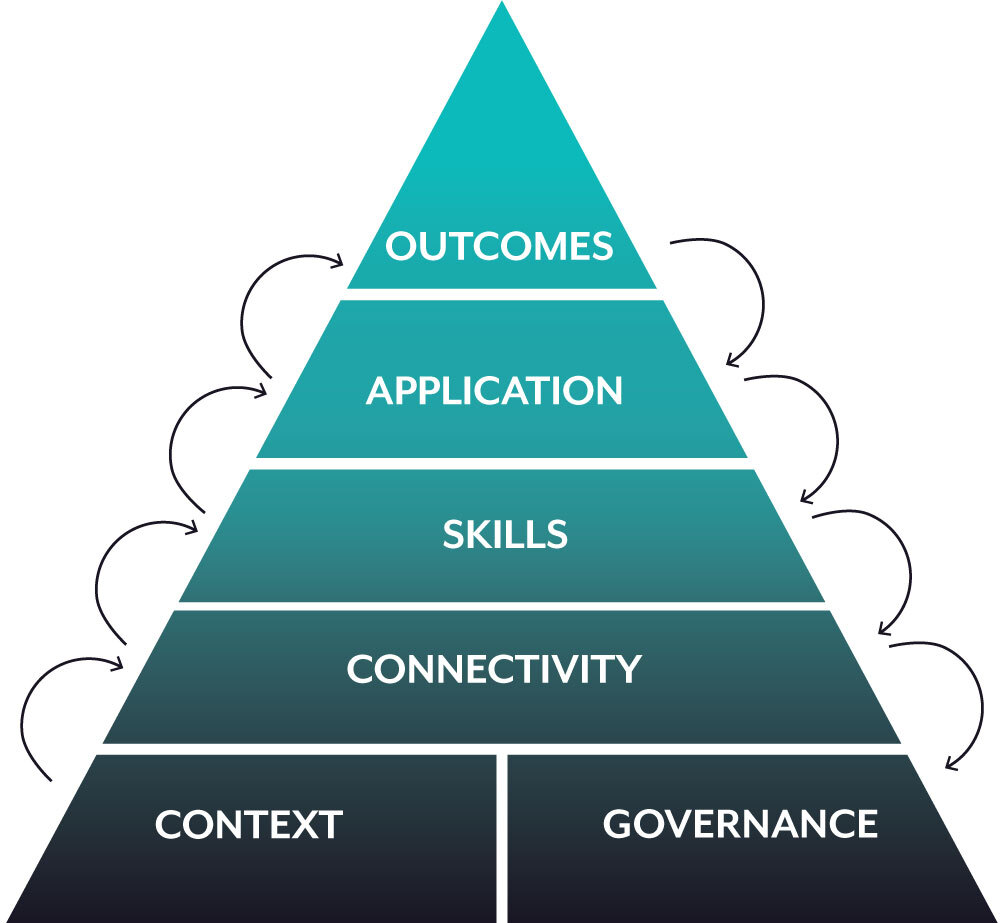
#1. Contexts—indicators related to sociodemographic, economic, and community level factors.
#2. Governance—indicators related to local, state, and federal policy, governance, and power.
#3. Connectivity—indicators related to the existence of necessary network infrastructure, as well as the accessibility, affordability, and adoption of internet service and network-enabled devices.
#4. Skills—indicators related to a broad range of activities centered around digital literacy (including secure online practices), training, and skills attainment.
#5. Application—indicators related to the uses and application of digital connectivity and skills, while considering additional sociotechnical contexts.
#6 Outcomes—indicators related to the broader effects of improved digital equity on individuals, communities, and states.
Potential Benefits
The Digital Opportunities Compass has several potential benefits for local, county and state policymakers. It can be used as a vehicle for inter-organizational collaboration and engagement, as well as a holistic framework for broadband and digital equity planning, implementation and evaluation, particularly for communities that may not know where to begin.
The Compass can be used to:
- Identify key groups of factors that influence digital equity efforts and outcomes
- Measure and assess digital equity efforts and outcomes over time
- Utilize a standardized core set of metrics that can be expanded and customized to meet state and community needs
- Build, as far as possible, on existing data and indices
- Augment existing data with new (qualitative and quantitative) data
- Innovatively design infrastructure to help automate data collection (e.g., quality measurement in routers)
Using the Digital Opportunities Compass in Practice
The Digital Opportunities Compass is a holistic set of metrics to monitor, evaluate, and guide state broadband policy. The framework is offered to support state agencies as they develop their digital equity plans this year. The Compass is also a comprehensive framework to ensure that additional factors and contexts are considered that research has shown can influence the outcomes and impacts of digital inclusion and broadband adoption initiatives.
The Digital Opportunities Compass is intended to be a starting point, rather than the final word, regarding the development of a comprehensive assessment framework to monitor, evaluate and guide state broadband and digital equity policy—now and in the future.
In this context, the Compass seeks to be useful both during the early stages of the Broadband Equity, Access, and Deployment (BEAD) and Digital Equity Act (DEA) grant programs this year , as well as during and at the end of the grant programs. The Compass should be useful to the National Telecommunications Administration as the agency seeks to develop a comprehensive and humanistic evaluation framework to assess the outcomes and impacts of these national programs.
Beyond IIJA, we hope that the Digital Opportunities Compass encourages deeper discussion, debate, and reflection not only regarding how to measure digital equity, but also to inspire new directions for research, practice, and policy in an increasingly networked society that demands broadband connectivity.
Download the full working paper, Digital Opportunities Compass: Metrics to Monitor, Evaluate, and Guide Broadband and Digital Equity Policy, from the Quello Center for Media and Information Policy at Michigan State University.
Dr. Colin Rhinesmith moderated a session at Net Inclusion 2023, titled “Building Local Digital Inclusion Ecosystems,” on Wednesday, March 1st at 10:00am (CT) (archived at https://www.youtube.com/watch?v=6YZPe3ZkWJ0, starting at 58:20) and Pierrette Renée Dagg participated in a livestream session, titled “Demonstrating Impact: Strategies and Methods for Evaluating Programs” on March 1st at 2:00pm (CT) (archived at https://www.youtube.com/watch?v=6YZPe3ZkWJ0, starting at 5:28:12).
Colin Rhinesmith (he/him) is the Founder and Director of the Digital Equity Research Center at the Metropolitan New York Library Council, a Research Fellow with the Quello Center for Media and Information Policy at Michigan State University, and a Co-Editor-In-Chief of The Journal of Community Informatics. Rhinesmith’s research examines the role of community informatics projects in creating and sustaining healthy digital equity ecosystems. Previously, Dr. Rhinesmith was an Associate Professor and Director of the Community Informatics Lab in the School of Library and Information Science at Simmons University. He has been a Google Policy Fellow and an Adjunct Research Fellow with New America’s Open Technology Institute, a Senior Fellow with the Benton Institute for Broadband & Society, and a Faculty Associate with the Berkman Klein Center for Internet & Society at Harvard University.
Pierrette Renée Dagg (she/her) is the director of Technology Impact Research for Merit Network at the University of Michigan in Ann Arbor, Michigan. The aim of her work is to bridge the gap between academic scholarship and practical application to positively impact technology and information equity. She is currently a PhD candidate at the University of Toledo in Social and Philosophical Foundations of Education and Education Technology, where she is completing a dissertation on AI in education. She is also a co-instructor at the University of Toledo. Prior to joining Merit, Pierrette held the position of Creative Director at Crain’s Detroit Business magazine. She has been the recipient of multiple awards from the Society of Professional Journalists, PRism, the National Academy of Television Officers and Advisors and was also an Emmy nominee. Pierrette graduated from the University of Toledo in Interdisciplinary Studies and earned the Magna Cum Laude distinction. She was also a member of Phi Kappa Phi and was named the Distinguished Graduating Scholar by the College of Adult and Lifelong Learning. Pierrette completed her Executive MBA from the University of Toledo College of Business and Innovation in September, 2018. She is a member of the International Artificial Intelligence in Education Society, the American Educational Research Association, the Michigan Council for Women in Technology, and the Pop Culture/American Culture Association.
Johannes M. Bauer (he/him) is Professor in the Department of Media and Information and the Director of the Quello Center for Media and Information Policy at Michigan State University. His research explores institutional choice and design problems raised by emerging technologies. Among other topics, he explores how public policy and management affect the benefits and risks of advanced information and communication technologies for individuals, communities, and society. He is currently working on a book on the governance of complex adaptive socio-technical systems.
Greta Byrum (she/they) is a digital equity practitioner and researcher working in the field since the 2010 Broadband Technology Opportunity Program. Over the last decade, she launched the Just Tech Program at the Social Science Research Council; founded Community Tech NY, a non-profit building collaborative community-owned broadband ecosystems with local partners; built the New School’s Digital Equity Lab; founded the Resilient Communities Program at New America, and led the Field Team at New America’s Open Technology Institute. Greta has a background in urban planning, communication technologies, and poetry, and serves on the boards of the Metropolitan New York Library Council, the Southern Connected Communities Project, the Howland Public Library Board of Directors, and the New York State Regents’ Advisory Board on Libraries.
Aaron Schill (he/him) is Director of Research & Programs at the National Digital Inclusion Alliance (NDIA). Aaron joined the NDIA team in January 2022. He is experienced at working with local leaders and elected officials to build consensus and develop place-based solutions to the most pressing community challenges. Throughout his career, Aaron has advocated for data and information access to empower communities to affect positive change. Prior to joining NDIA, Aaron was the director of data and mapping at the Mid-Ohio Regional Planning Commission, where he headed the agency’s work in data analytics, visualization, and GIS. He also established the organization’s strategy and programming for broadband and digital inclusion and co-led the creation of the Franklin County Digital Equity Coalition. Aaron’s career experience includes working as an urban planner and research director primarily in public and nonprofit organizations. He is a two-time graduate of The Ohio State University, with a master’s degree in city and regional planning and a bachelor’s degree in sociology.
The Benton Institute for Broadband & Society is a non-profit organization dedicated to ensuring that all people in the U.S. have access to competitive, High-Performance Broadband regardless of where they live or who they are. We believe communication policy – rooted in the values of access, equity, and diversity – has the power to deliver new opportunities and strengthen communities.
Reposted from the Benton Institute for Broadband & Society Daily Beat, February 28, 2023 (access original post here). © Benton Institute for Broadband & Society 2023.